Episode 5He Swallowed Five. Not This One.Cronus and Rhea
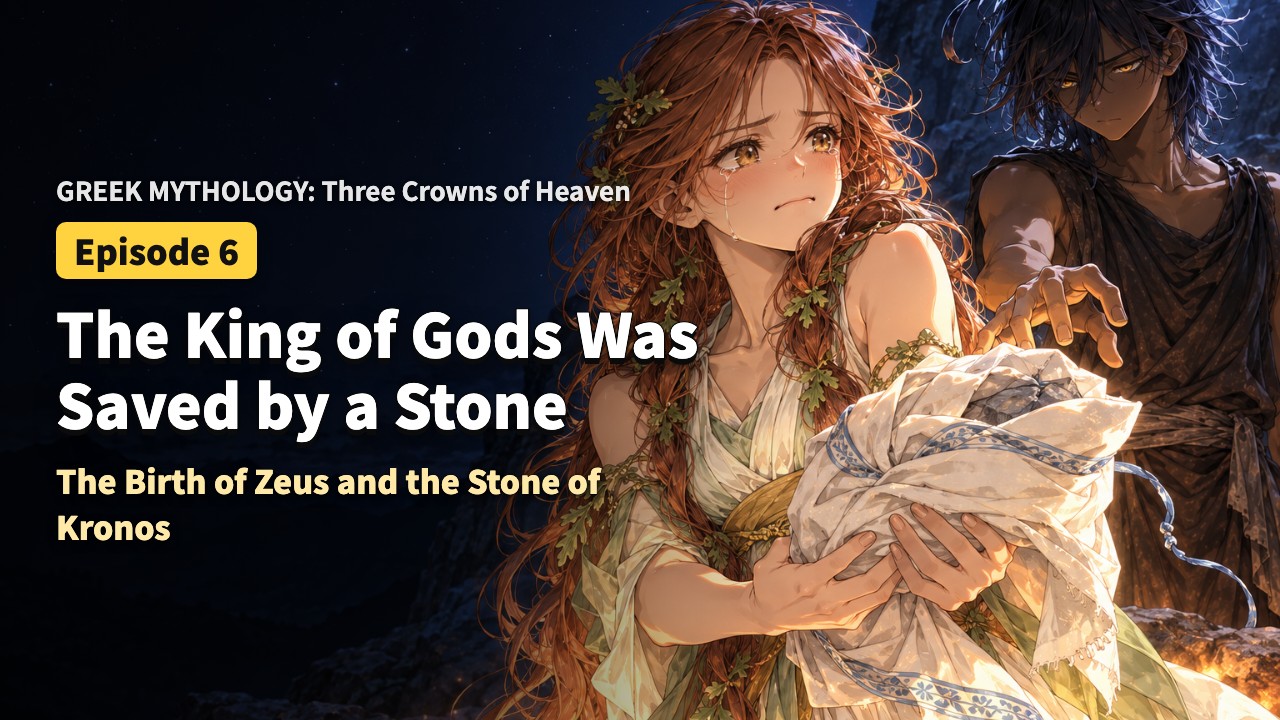
Episode 5. Cronus overthrew his father to become king, but one prophecy haunts him, so he swallows each of his five newborn children one after another. Grieving and carrying a sixth child, their mother Rhea asks Earth and Sky for help. Holding close the stone Earth gave her, she crosses the night sea, resolved that this time she will protect her child.
Cronus Swallows His Children: The Myth of Cronus and Rhea Explained
The Original Myth: What Hesiod Tells Us
The story of Cronus swallowing his children comes from the Theogony, a poem by the Greek poet Hesiod composed around 700 BCE. It tells how the gods came into being and how Zeus came to rule. The passage behind this episode is short, only about fifteen lines (453–467), and it is dense.
Rhea, a Titan goddess, bears children to Cronus, the king of the gods. Hesiod uses a Greek word here that can mean she was "overpowered" by him or simply "joined" with him, so readers disagree about how much force it implies. Hesiod then names the children: Hestia, Demeter, Hera "of the golden sandals," Hades the pitiless lord who lives beneath the earth, the loud-roaring Earth-Shaker (Poseidon, who is not named directly), and wise Zeus, the future father of gods and men.
Each time a child comes from Rhea's womb to his knees, Cronus swallows it. His reason is simple: he does not want anyone else among the gods to hold royal power. Earth (Gaia) and starry Sky (Uranus), his own parents, had warned him that for all his strength he was fated to be overthrown by his own child. So he never lets down his guard. He watches, waits, and swallows, and Rhea is left with a grief she cannot forget. That is where the passage ends.
What Happens Next in the Theogony
The manga carries the story a little past that point, into the next lines of the poem (468–484). When Rhea is about to give birth to Zeus, her youngest child, she begs her parents, Earth and Sky, to help her bear him in secret and to make Cronus pay for what he did to his father and to her children. They listen, tell her what fate holds for Cronus and his son, and send her to Lyctus, a rich town on the island of Crete. Earth herself takes the baby to raise in Crete.
Hesiod says the child was carried "through the swift, dark night" to Lyctus. Grammatically, the one who carries him could be Earth or Rhea, and translators read it differently. A little later in the poem comes the famous trick: Cronus is handed a stone wrapped in baby clothes, and he swallows it in place of Zeus.
What This Myth Is About
Cronus and Rhea belong to what scholars call a "succession myth": a chain of kings, each overthrown by his son. Earlier in the Theogony (lines 154–182), Cronus took power by attacking his father Uranus. Now he fears the same fate, and his attempt to escape it is what brings it about. Many readers see this as one of the oldest stories about a ruler who destroys his own future in order to hold on to power.
Scholars have also noticed parallels with succession stories from the ancient Near East, especially the Hurrian-Hittite tale of the god Kumarbi, which also involves swallowing and a stone. Some think Greek poets knew these traditions, though how they spread is debated.
Hesiod's larger aim is to explain why Zeus deserves to rule. Cronus is called "crooked-minded" and grasping, while Zeus is described as wise even before he is born. Rhea's grief and her demand for justice are what set Zeus's victory in motion.
What the Manga Changes and Adds
Hesiod covers the swallowings in a single sentence. The manga turns them into separate scenes: each baby's face, cries, and the moment it is taken. Some details hint at who the children will become, such as Hera's golden sandals, Hades' hard heart, and Poseidon's roar. These grow out of the epithets Hesiod gives them. The birth order is also an interpretation. Hesiod only states that Zeus was the youngest. Treating the list as Hestia first through Poseidon fifth is a common reading, but the poem does not say so outright.
Rhea's shifting emotions, Cronus's expressions and inner struggle, the scene where the prophecy is delivered, and the palace, costumes, and landscapes are all invented for the manga. Hesiod gives only Cronus's fear for his throne and Rhea's lasting grief. The manga also shows the swallowed children alive inside their father. The poem never says this, but it fits, since they come out alive later in the Theogony.
Two bigger changes affect the plot. First, the manga has Rhea pregnant when she goes to her parents, while Hesiod places her plea just before the birth. Second, in the manga Earth gives Rhea a stone and Rhea herself crosses the night sea. Hesiod does not describe a stone being handed over before the journey, and he leaves open who carried the child through the night. The manga's version is one reasonable reading of that ambiguity, and the role of Earth as protector, which is central in the poem, is still there.
Where to Read It
If you want to see this myth told visually, from Cronus's watchful fear to Rhea's journey through the dark, Episode 5 of GREEK MYTHOLOGY: Three Crowns of Heaven, "He Swallowed Five. Not This One.", is right here on Manga Portal. Every episode is free, and you don't need an account. It pairs well with Hesiod's Theogony, which is short enough to read in an afternoon in any modern translation and lets you compare the original lines with the manga's version.
Characters in this episode
Cronus
The Titan king of the gods, who swallows his newborn children because of a prophecy that one of them will overthrow him.
Rhea
Cronus's wife and the mother of six gods, whose unforgettable grief drives her to save her youngest child, Zeus.
Gaia (Earth)
The primordial Earth goddess, mother of Cronus and Rhea, who foretells Cronus's fate and later takes in the infant Zeus on Crete.
Uranus (Sky)
The starry Sky, father of Cronus and Rhea, who even after being overthrown shares the prophecy with Gaia.
Zeus
The sixth and youngest child of Cronus and Rhea, destined to overthrow his father and become ruler of the gods.
Hestia, Demeter, Hera, Hades, and Poseidon
The five older children of Cronus and Rhea, each swallowed by their father at birth.
FAQ
Why did Cronus eat his children?
His parents, Gaia and Uranus, warned him that he was fated to be overthrown by one of his own children. To keep his throne, he swallowed each child as soon as it was born. In Hesiod's Theogony, his goal is that no other god will ever hold royal power.
Which children did Cronus swallow?
Hesiod lists six children of Cronus and Rhea: Hestia, Demeter, Hera, Hades, Poseidon, and Zeus. Cronus swallowed the first five. Zeus, the youngest, was saved when Rhea hid him on Crete.
How was Zeus saved from Cronus?
Rhea asked her parents, Earth and Sky, for help, and they sent her to Lyctus on Crete, where Earth took the baby to raise in secret. Cronus was given a stone wrapped in baby clothes and swallowed it in place of Zeus.
Were Cronus's children alive inside him?
Hesiod does not describe what happened inside Cronus. Later in the Theogony, though, the swallowed children are brought back up and go on to fight beside Zeus, so retellings usually show them as alive.
Is Cronus the same as Chronos, the god of time?
No. Cronus (Kronos) the Titan and Chronos, meaning "time," are different words and originally different figures. Ancient writers later blended the two because the names sound alike, which is where the image of Cronus as "Father Time" comes from.