Episode 4Darkness Fell. Why Are the Gods Laughing?The Heavenly Rock Cave (Ama-no-Iwato)
When the sun goddess Amaterasu shuts herself inside a rock cave, the world falls into darkness. The gods throw a festival outside her door and use laughter to draw the light back out. Her younger brother Susanoo brought on the darkness. He is the only one who can't laugh, and the gods banish him to the land below. There he stops when he hears someone crying upstream.
Amaterasu and the Rock Cave (Ama-no-Iwato): Kojiki Myth Explained
The Original Myth: The Sun Goddess Hides
This story comes from the first volume of the Kojiki ("Record of Ancient Matters"), compiled by Ō no Yasumaro in 712 and the oldest surviving book in Japan. It begins right after Susanoo, the storm god, has run wild in Takamagahara, the High Plain of Heaven. He breaks open the roof of the sacred weaving hall and throws in a heavenly dappled horse that he has skinned backwards. One of the weaving maidens is so startled that she is fatally injured by her own shuttle.
Amaterasu, the sun goddess and Susanoo's older sister, is frightened by what she has seen. She goes into the Heavenly Rock Cave (Ama-no-Iwato) and shuts the door. Heaven and the world below, called the Central Land of Reed Plains, both go dark, and the night does not end. The voices of countless gods buzz like swarms of summer flies, and disasters of every kind break out. The Kojiki never says how long the darkness lasted.
The "eight million gods" gather on the dry bed of the Heavenly Peaceful River and ask Omoikane, the god of wisdom, to come up with a plan. Roosters from the Eternal Land are made to crow. The smith Amatsumara and the goddess Ishikoridome forge a mirror. Tamanoya makes a long string of curved jewels (magatama). Two priestly gods, Ame-no-Koyane and Futodama, read omens from a deer's shoulder blade, then dig up a sacred sakaki tree, roots and all. On it they hang the jewels at the top, the mirror in the middle, and white and blue cloth below. Futodama holds the tree up as an offering while Ame-no-Koyane recites a solemn prayer. Ame-no-Tajikarao, whose name means "heavenly strong hand," hides beside the door.
Then Ame-no-Uzume, a goddess, steps forward. She wears a vine as a sash and a headdress of creepers, and she holds a bundle of bamboo leaves. She turns a tub upside down in front of the cave and stamps on it until it booms. Possessed by the gods, she bares her breasts and pushes the cord of her skirt down to her genitals. All of heaven shakes as the eight million gods burst out laughing.
How the Light Returns, and Why Susanoo Is Banished
Puzzled, Amaterasu opens the door a crack and asks why Uzume is dancing and the gods are laughing when the world should be dark without her. Uzume answers that a god even nobler than Amaterasu has come, and that is why they are celebrating. While she speaks, the two priests hold out the mirror. Amaterasu finds this stranger still and leans a little way out. At that moment Tajikarao takes her hand and pulls her out, and Futodama stretches a sacred rope behind her, telling her she cannot go back in. Heaven and earth fill with light again.
Many retellings say Amaterasu mistook her own reflection for a rival goddess. The Kojiki doesn't actually say this. It only says she grew more and more curious, so the reflection story is a later interpretation, not something the text states.
Next, the gods decide on a punishment. Susanoo has to pay a huge fine of offerings, his beard is cut off, his fingernails and toenails are pulled out, and he is driven out of heaven.
The Kojiki then adds a short episode without saying when or where it takes place. Susanoo asks the food goddess Ōgetsuhime for something to eat. She takes delicacies from her nose, mouth and rear and prepares them. Susanoo watches her, decides she is serving him defiled food, and kills her. From her body grow silkworms (from her head), rice (eyes), millet (ears), red beans (nose), wheat (genitals) and soybeans (rear). The creator deity Kamimusubi has these gathered as seeds.
What the Myth Means: Cultural Background
Nearly every object in this scene, including the mirror, the jewels, the sakaki branch, the formal prayer and the divination, belongs to Shinto ritual. For that reason, many scholars read the episode as a story about where those rites came from. Ame-no-Koyane and Futodama were traditionally honored as ancestors of priestly clans. Uzume's dance is often described as the mythic origin of kagura, a form of sacred dance, and Futodama's rope is often linked to the shimenawa ropes that mark sacred spaces today.
No one knows for certain why the sun hides in the myth. Some scholars think it remembers a solar eclipse. Others connect it to winter-solstice rituals meant to renew the sun's strength. It's also worth noticing that the gods don't use force to end the darkness. They use a festival, and it's laughter that turns things around.
The Ōgetsuhime episode explains where staple crops come from: food grows out of a death. Scholars have compared it with similar myths elsewhere, such as the Hainuwele story from Indonesia. Later in the Kojiki, a mirror and curved jewels are given to Amaterasu's grandson when he descends to rule the earth. Many readers connect them to Japan's imperial regalia.
What the Manga Changes
The manga keeps the core events of the original: the darkness, the gathering of the gods, the mirror, Uzume's dance, the laughter, Tajikarao pulling Amaterasu out, and Susanoo's banishment.
The idea of Susanoo as the only god who can't laugh comes from the manga. The Kojiki doesn't record anything he says or feels while he is punished, so we can't tell from the text whether he is sorry, angry or silent. The manga also invents things the original only lists or leaves out entirely: what the endless night looked like, how Omoikane worked out his plan, what Amaterasu was thinking inside the cave, and the gods' faces when the light came back.
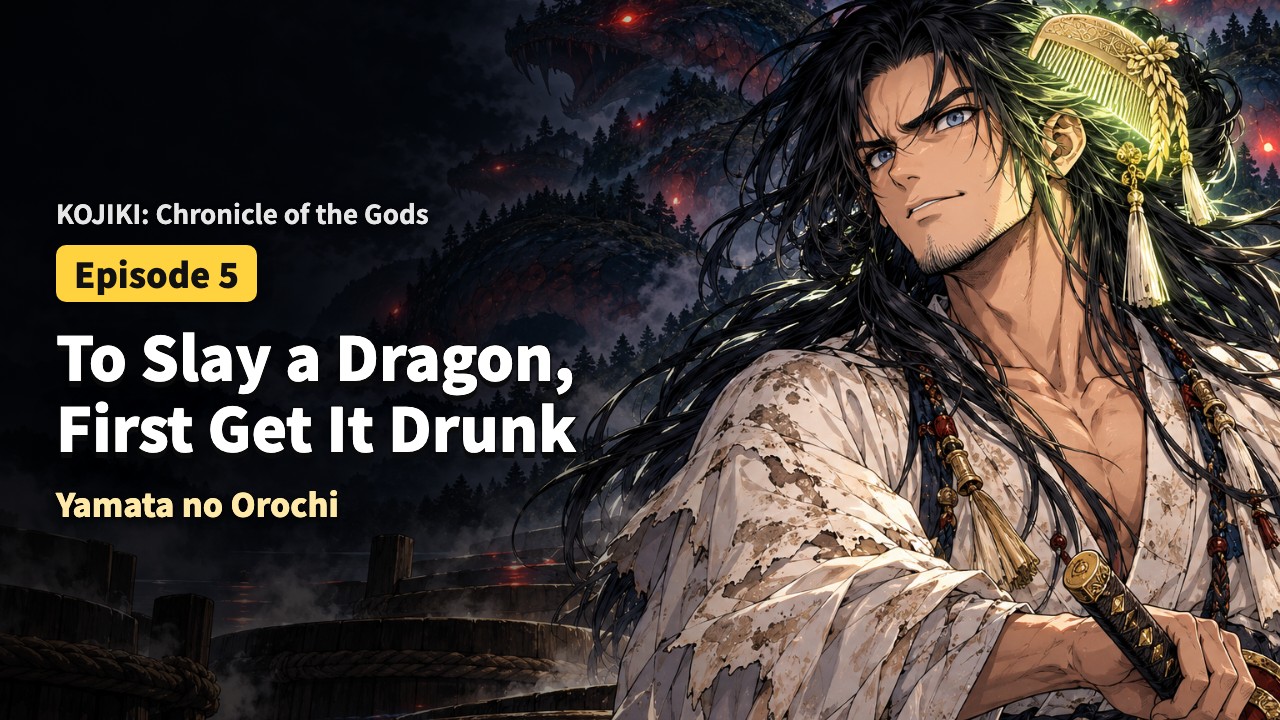
The ending is adapted as well. In the Kojiki, Susanoo later arrives in Izumo, sees chopsticks floating down a river, and follows it upstream to find an elderly couple weeping. That meeting leads into the famous story of the eight-headed serpent Yamata no Orochi. The manga turns this into a sound he hears as he travels.
Where to Read It
If you want the original, the Kojiki is available in several complete English translations, including those by Basil Hall Chamberlain (1882), Donald L. Philippi (1968) and Gustav Heldt (2014). If you'd like to see the story first, KOJIKI: Chronicle of the Gods tells it from the beginning, and every episode on Manga Portal is free to read with no sign-up. Episode 4 is a good place to see how a dark, strange ancient text becomes a story about laughter, and to follow Susanoo toward the cry that leads into his next adventure.
Characters in this episode
Amaterasu (the sun goddess)
Ruler of the High Plain of Heaven, whose retreat into the Rock Cave plunges both heaven and earth into darkness.
Susanoo (the storm god)
Amaterasu's younger brother, whose violence causes the crisis and who is punished and banished from heaven.
Ame-no-Uzume (goddess of the dance)
The goddess whose wild, possessed dance makes the gods roar with laughter and draws Amaterasu to the door.
Omoikane (god of wisdom)
The god asked to come up with the plan to lure the sun goddess out of the cave.
Ame-no-Tajikarao (the strong-handed god)
The god who hides beside the cave door and pulls Amaterasu out by the hand.
Ōgetsuhime (the food goddess)
A goddess killed by Susanoo whose body gives rise to silkworms and Japan's staple grains.
FAQ
Why did Amaterasu hide in the cave?
According to the Kojiki, she was frightened after her brother Susanoo wrecked the sacred weaving hall and a weaving maiden died. She shut herself inside the Heavenly Rock Cave, and the whole world went dark.
Did Amaterasu see her reflection in the mirror?
That's a popular retelling, but the Kojiki doesn't say it. The text only says that when the gods held up the mirror, she found the situation even stranger and leaned out, and then she was pulled from the cave.
Who is Ame-no-Uzume and why is her dance famous?
Ame-no-Uzume is the goddess who danced on an upturned tub outside the cave and made the gods laugh so hard that heaven shook. Her dance is often described as the mythic origin of kagura, Japan's sacred dance.
Why was Susanoo banished from heaven?
The gods held him responsible for the chaos that led to the darkness. They made him pay a large fine of offerings, cut off his beard, pulled out his nails and drove him out of the High Plain of Heaven.
Where do rice and grains come from in Japanese mythology?
In the Kojiki, Susanoo kills the food goddess Ōgetsuhime, and silkworms, rice, millet, red beans, wheat and soybeans grow from her body. The deity Kamimusubi has them gathered as the first seeds.